India’s Processed Food Opportunity: Growth Is Accelerating. Regulatory Compliance Must Keep Pace.
August 14, 2026
India’s processed food industry is entering one of its strongest periods of expansion. But the same forces creating opportunity—larger product portfolios, faster launches, exports to multiple markets and stronger consumer scrutiny—are also making regulatory compliance significantly more important.
The emerging equation for food businesses is straightforward:
Market Opportunity + Regulatory Readiness = Sustainable Growth
A Significant Domestic and Export Opportunity
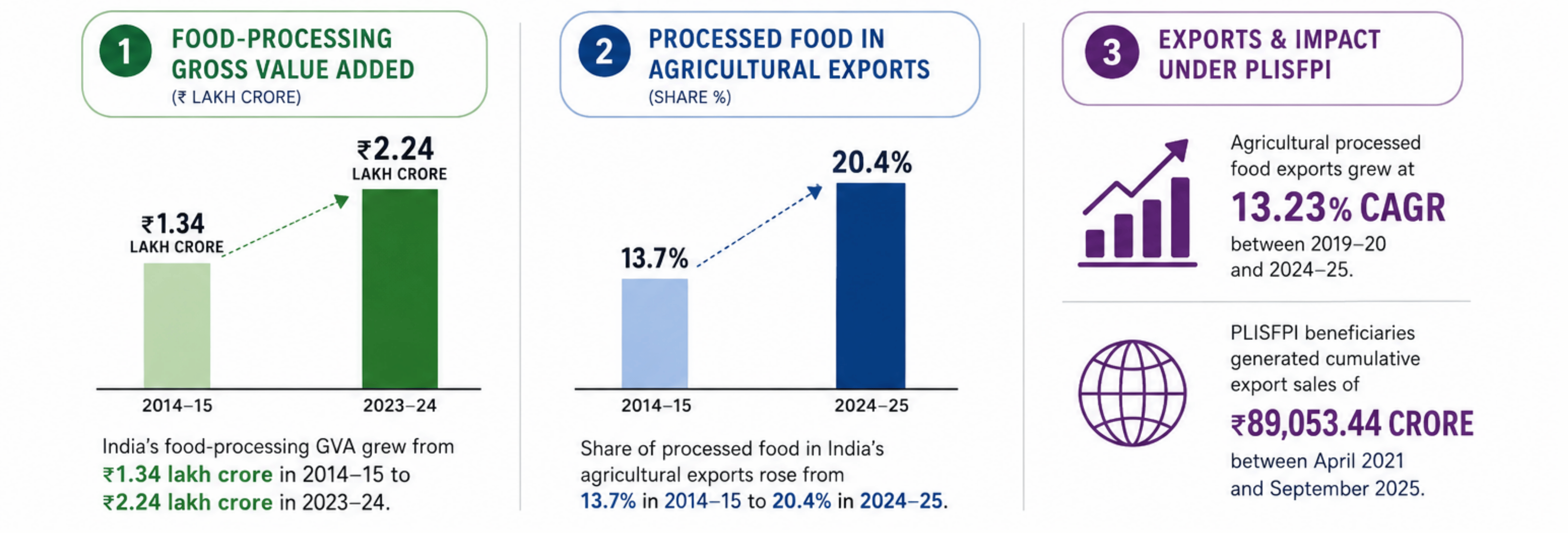
India’s food-processing Gross Value Added increased from ₹1.34 lakh crore in 2014–15 to ₹2.24 lakh crore in 2023–24. More importantly, processed food is becoming increasingly significant within India’s agricultural exports: its share increased from 13.7% in 2014–15 to 20.4% in 2024–25.
The Government is actively accelerating this transition. Under the ₹10,900 crore Production Linked Incentive Scheme for Food Processing Industries (PLISFPI), 165 applications covering 274 project locations had already been approved by February 2026. The scheme had supported 34 lakh MT per annum of additional processing and preservation capacity and created approximately 3.39 lakh jobs.
The export trajectory is equally significant. Agricultural processed food exports under the scheme recorded a 13.23% CAGR between 2019–20 and 2024–25, while PLISFPI beneficiaries generated cumulative export sales of ₹89,053.44 crore between April 2021 and September 2025.
Government support extends beyond manufacturing. PLISFPI explicitly encourages Indian companies to build brands overseas, including reimbursement of 50% of eligible international branding and marketing expenditure, subject to prescribed limits.
India therefore has an unprecedented opportunity to move from being a major agricultural producer to becoming a major global supplier of value-added, packaged and branded foods.
But Market Access Comes With Regulatory Compliance
For an exporter, manufacturing a good product is only part of market readiness. The product must also comply with the destination country’s requirements for ingredients, additives, allergens, nutrition information, mandatory declarations, product identity, claims, warning statements, language and label presentation.
A product that is acceptable in India may therefore require a substantially different regulatory and labelling treatment for the United States, Canada, the EU, UK, GCC, Australia-New Zealand or other markets.
This makes mislabelling more than an artwork error.
At export scale, a labelling error can become a market-access failure—potentially resulting in detention, rejection, relabelling, shipment delays, product withdrawal, additional testing, distributor disputes and reputational damage. The commercial impact extends far beyond the cost of correcting a label.
As Indian companies expand from a few export destinations to multiple countries and from tens of products to hundreds of SKUs, relying predominantly on manual regulatory interpretation and repetitive artwork checking becomes increasingly difficult to scale.
Domestic Scrutiny Is Increasing Too
The regulatory direction within India reinforces the same message.
FSSAI’s mandate explicitly includes regulating and monitoring food distribution and sale to protect public health, setting food standards and establishing food-labelling requirements.
Labelling continues to receive significant policy attention. In February 2025, FSSAI notified draft amendments relating, among other matters, to the presentation of nutrition information. By November 2025, the proposal had progressed to consideration by the Food Authority.
Compliance Must Become Growth Infrastructure
The strategic implication for food companies is important.
Historically, regulatory compliance was often treated as a final checkpoint before artwork approval or product launch. That operating model becomes increasingly fragile when companies are simultaneously managing:
hundreds or thousands of SKUs,
frequent formulation and packaging changes,
multiple manufacturing locations,
faster innovation cycles,
domestic FSSAI and Legal Metrology requirements, and
different regulations across multiple export markets.
The next generation of food businesses will therefore need to treat regulatory capability much like manufacturing capacity or supply-chain infrastructure.
Product Compliance → Compliant Label Generation → Label Validation → Approval & Audit Trail → Market Launch
Each layer needs to be systematic, repeatable and scalable.
The Strategic Imperative
India already has the agricultural base. Manufacturing capacity is expanding. Government incentives are supporting investment and brand building. Processed-food exports are growing at double-digit rates.
The missing competitive advantage cannot be regulatory readiness.
For Indian food businesses seeking to capture domestic growth and build international brands, compliance is no longer only about avoiding regulatory action. It is about protecting market access, accelerating launches, reducing export risk and building consumer and customer trust.
The companies best positioned to capture India’s processed-food opportunity will therefore not simply be those that manufacture at scale.
They will be those that can comply at scale.
India's food industry is innovating faster than ever. New ingredients, formats, claims, categories and market channels are emerging continuously. Yet one of the most business-critical stages of a product launch, regulatory label validation, continues to depend heavily on manual interpretation, fragmented checklists and repeated reviews.
The result is a significant compliance gap.
LabelBlind®'s India Labelling & Claims Compliance Study, covering more than 500 food products and 6,000 claims across 17 categories, found that only 66.4% of the labels and claims reviewed were compliant. A further 21.3% were non-compliant, while 12.3% required verification from the brand.
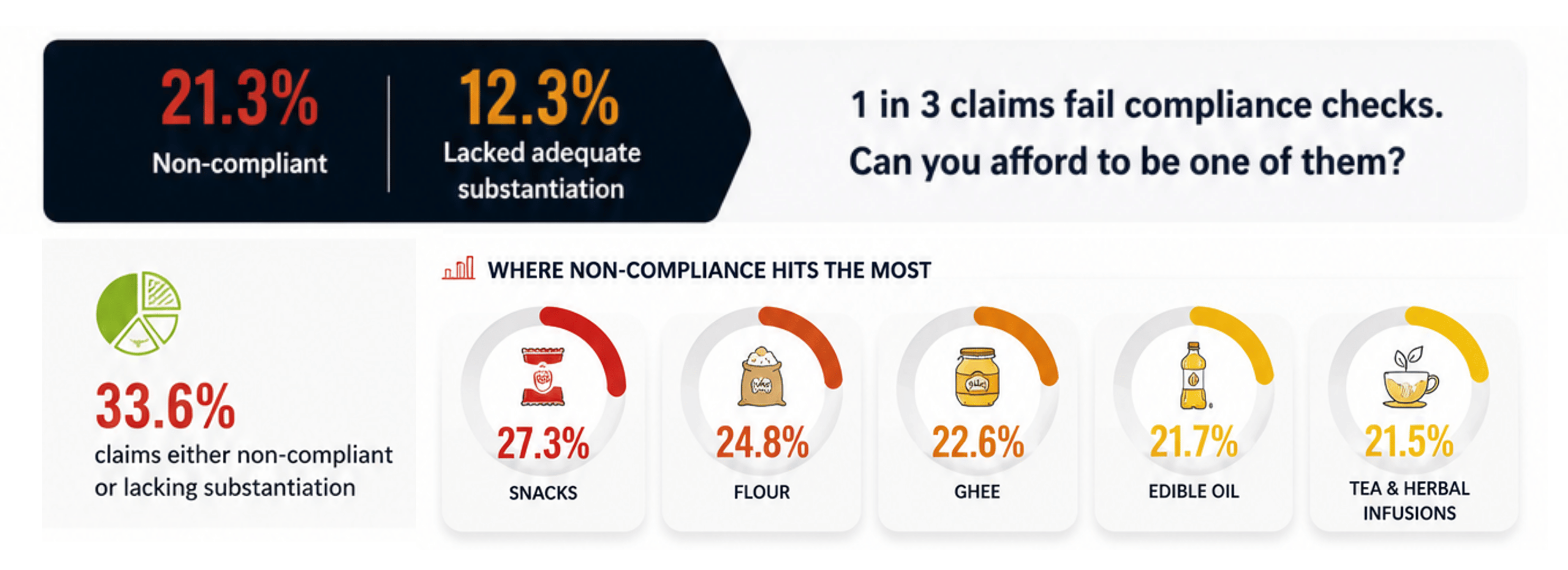
The gaps were visible across categories. Non-compliance levels were especially high in plant-based beverages, ready-to-eat meals, snacks, dairy-based ready-to-drink products, beverages, flours, edible oils and protein powders.
These are not merely technical errors. A missing declaration, incorrect claim, inadequate font height or wrongly presented nutrition panel can lead to:
Artwork rework and packaging wastage
Delayed product launches
Regulatory notices and reputational risk
Repeated dependence on regulatory teams
Inconsistent interpretation across products and reviewers
Export and marketplace acceptance challenges
The industry did not need another checklist. It needed a new compliance system. What it got was something more ambitious: a demonstration that an entire national regulatory rulebook could be turned into logic a machine could run in minutes and a first step toward doing the same for every market a food brand wants to enter.
The Solution: Regulatory Compliance Software
FoLSol® AI is built to validate a food label against more than 70 FSSAI and Legal Metrology parameters, and to produce a structured set of observations in minutes rather than the hours a manual review typically takes.
Regulatory professionals know exactly how much judgment, cross-referencing and category-specific nuance sits behind each of those 70+ parameters, whether a claim is supported, whether a declaration's font height meets the prescribed threshold, whether an exemption applies because of a package size or a point-of-sale condition. Compressing that into a repeatable, minutes-long process required believing that regulatory judgment could be deconstructed, parameter by parameter, into deterministic logic without losing its rigour.
The first challenge was to convert complex food regulations into a structured, machine-readable regulatory knowledge system. LabelBlind®'s regulatory experts deconstructed the regulations into individual compliance parameters, conditions, exceptions and cross-references, asking, for each requirement: When does a rule apply? What evidence must be present on the label? What format is acceptable? What constitutes a deviation? Which observations require expert interpretation? This regulatory rule library became the foundation of the validation model.
The next stage involved creating the label-data extraction architecture. Optical character recognition, visual interpretation and language-model capabilities were brought together to identify and organise information from complex artworks, distinguishing between a marketing statement and a statutory declaration, and connecting a claim in one part of the artwork with its qualifying statement elsewhere. Extracted data was then mapped to the regulatory rule engine for parameter-wise validation.
Why This Matters to the Food Industry
Speed without compromising regulatory control. The system can complete a structured initial review within minutes, allowing experts to focus on exceptions and higher-order judgement.
Consistency across labels and teams. The same regulatory logic is applied across products, brands and reviewers, reducing dependence on individual interpretation.
Improved traceability. Observations can be linked to the relevant compliance requirement, supporting internal review and audit readiness.
Faster artwork approvals. Potential gaps can be identified before printing, reducing correction cycles, packaging wastage and launch delays.
Human expertise remains in control. FoLSol® AI is designed as a regulatory decision-support system not as a replacement for professional judgement. It helps regulatory teams review more intelligently, while experts retain responsibility for context, exceptions and final approval.
The rulebook has been converted into logic. The logic has been tested against real labels. And every checked parameter brings food businesses one step closer to safer, faster and more reliable compliance.
Manual Compliance Was Built for a Different Scale
Traditional regulatory processes typically depend on highly capable professionals working through regulations, spreadsheets, documents, emails, artwork files and multiple rounds of approvals.
It becomes increasingly difficult to scale without increasing three things simultaneously:
people, review time and management complexity.
More SKUs create more validations.
More countries create more regulatory interpretations.
More product changes create more label versions.
More claims create more risk.
More teams create more approval points.
And every additional manual hand-off creates another opportunity for inconsistency or omission.
This is precisely where enterprise-level regulatory technology becomes important.
Enterprise Regulatory Compliance Software Can Turn Compliance Into Infrastructure
The purpose of enterprise technology should not simply be to make an individual regulatory professional work faster.
It should create a common compliance architecture across the organisation.
A mature system can connect:
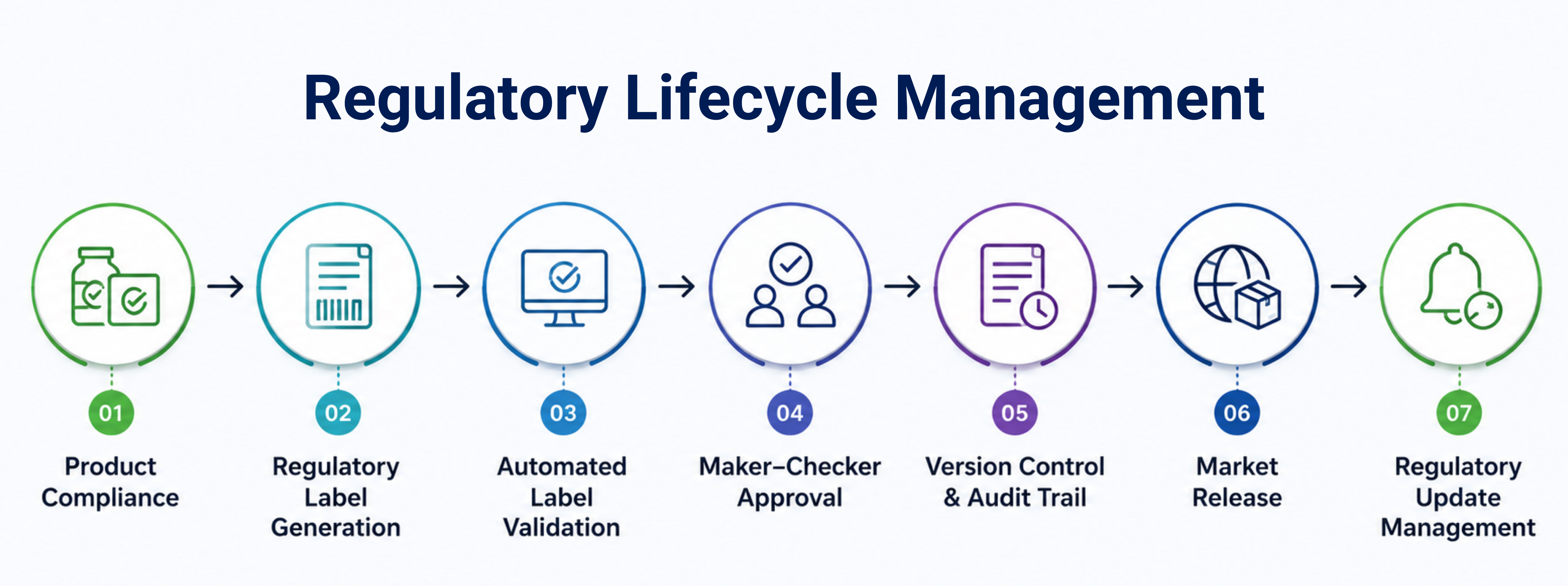
Instead of compliance knowledge remaining distributed across individuals, emails and spreadsheets, regulatory rules can increasingly become structured institutional knowledge.
That creates several advantages.
1. Consistency at Scale
The same regulatory parameters can be applied systematically across hundreds of labels rather than depending entirely upon different reviewers remembering every applicable requirement.
2. Compliance Earlier in Product Development
Ingredient permissibility, additives, nutrition, claims and category requirements can be evaluated before the artwork stage.
Compliance moves upstream, reducing expensive downstream corrections.
3. Automated Validation
Technology can perform repetitive deterministic checks across multiple regulatory parameters, leaving regulatory professionals to concentrate on interpretation, judgement and exceptions.
4. Multi-Country Scalability
Country-specific regulatory rules can be built into a common platform, enabling companies to expand internationally without requiring regulatory processes to grow linearly with every new market.
5. Traceability
Every validation, correction, approval and version can become part of an auditable compliance record.
For large companies, this is increasingly important because compliance must be demonstrated—not merely assumed.
From Compliance Function to Growth Infrastructure
The companies most capable of leveraging India's processed-food opportunity will therefore need to invest not only in factories, brands, distribution and innovation, but also in the infrastructure that protects their ability to reach markets.
Enterprise regulatory technology can transform compliance from a final label checkpoint into an integrated operating system spanning the entire product lifecycle.
And that leads to a larger strategic conclusion:
The Future of Food Compliance Is Not More Checking. It Is Better Architecture.
As India's food industry scales, the competitive question will increasingly become:
Can your compliance capability scale as fast as your business?
Because the winners in India's next phase of food growth will not simply be companies that can manufacture at scale or sell at scale. They will be companies that can comply at scale.

Michelle Britto
M.Sc. Foods, Nutrition and Dietetics, Registered Dietitian, Content Writer, Brand and Marketing Manager at LabelBlind® with over 7 years of experience
Recent Articles