Why Regulatory Compliance AI Needs Experts in the Loop?
September 4, 2026
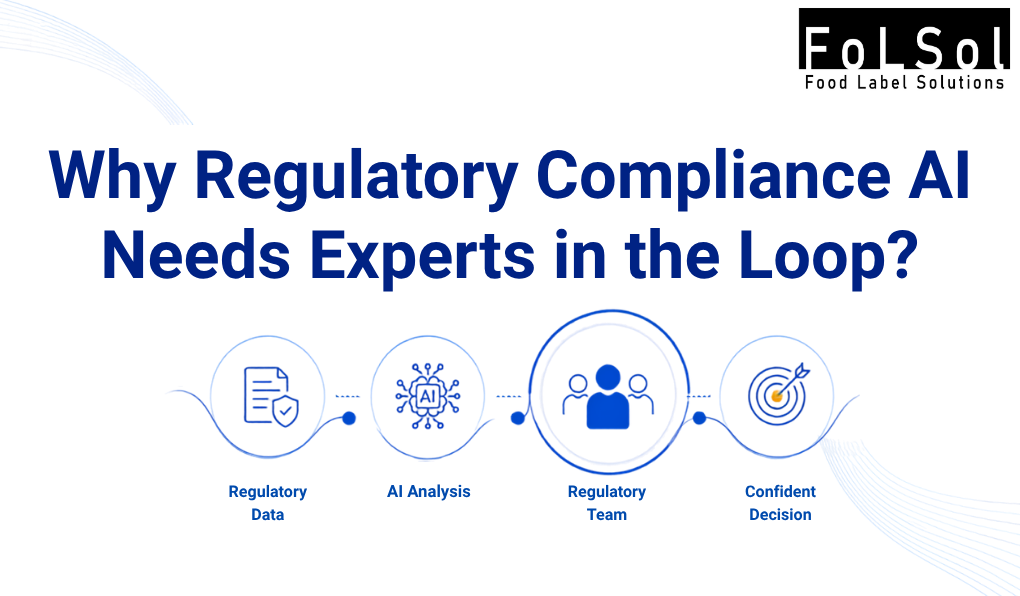
Regulatory Compliance AI Doesn't Replace Regulatory Teams - It is designed as a regulatory decision-support system.
FoLSol® AI is designed as a regulatory decision-support system, not as a replacement for professional judgement. It helps regulatory teams review more intelligently, while experts retain responsibility for context, exceptions and final approval.
Regulatory Compliance AI can extract information, run structured checks, identify patterns and perform repetitive validations at speed. Regulatory professionals bring interpretation, scientific understanding, risk assessment, business context and accountability.
Together, they can create a stronger compliance model, one that is faster, more consistent and better prepared for increasing regulatory complexity, in India and, eventually, in every market where a food brand wants to earn a place on the shelf.
What Regulatory Compliance AI Handles
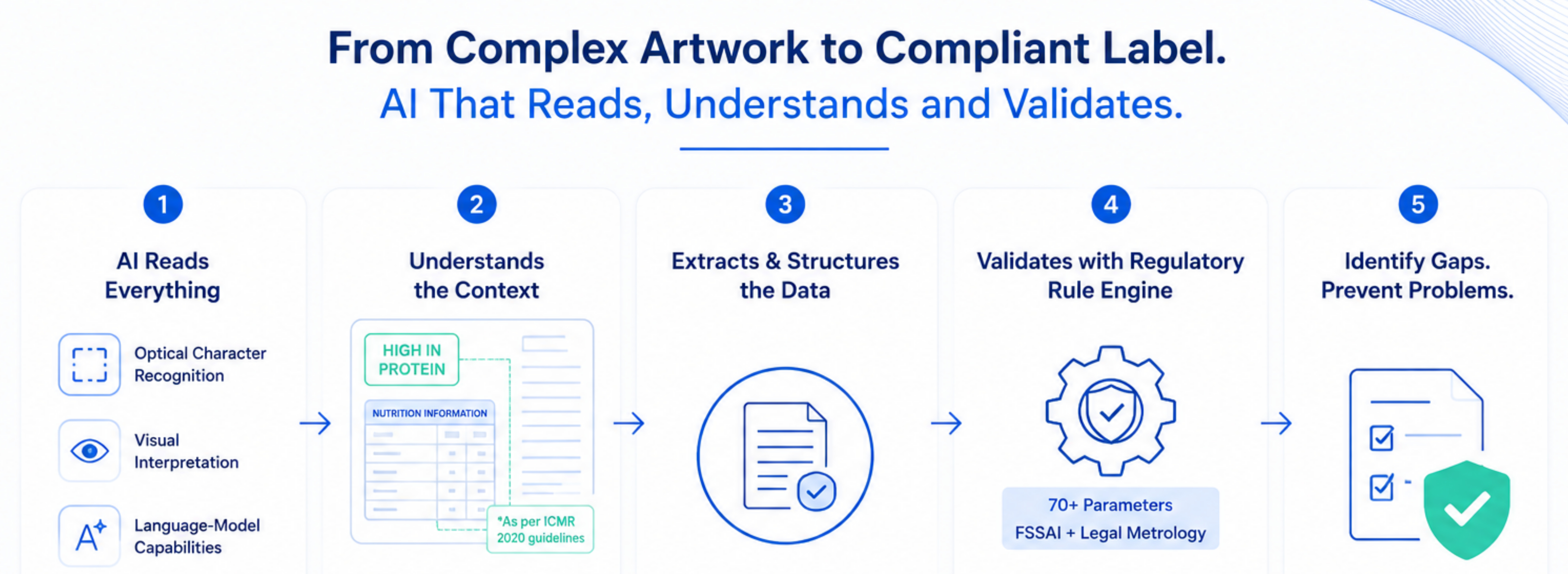
A food label is not a simple document. Information may appear across multiple panels, in different orientations, colours and font sizes. Text can be placed over graphics, wrapped around containers or repeated in different formats. Product names, ingredient lists, claims, nutrition panels and statutory declarations all have to be extracted and understood in context.
This is where the label-data extraction architecture does the work: optical character recognition, visual interpretation and language-model capabilities are brought together to identify and organise information from complex artworks, distinguishing between a marketing statement and a statutory declaration, and connecting a claim in one part of the artwork with its qualifying statement elsewhere. Extracted data is then mapped to the regulatory rule engine for parameter-wise validation, covering more than 70 FSSAI and Legal Metrology parameters in a single, consolidated review. Potential gaps can be identified before printing, reducing correction cycles, packaging wastage and launch delays.
FoLSol® AI was tested and trained using 100s of food labels representing a broad range of product categories, artwork structures, pack formats, ingredient declarations, nutrition tables, claims, statutory declarations and design complexities, from declarations placed vertically to inconsistent information across panels to distinguishing an ingredient claim from descriptive marketing copy. Every parameter had to earn its place in the model by demonstrating practical utility.
What Regulatory Professionals Retain
Speed without compromising regulatory control: the system can complete a structured initial review within minutes, allowing experts to focus on exceptions and higher-order judgement. Consistency across labels and teams: the same regulatory logic is applied across products, brands and reviewers, reducing dependence on individual interpretation. Improved traceability: observations can be linked to the relevant compliance requirement, supporting internal review and audit readiness.
Built Through Regulatory and Technical Collaboration
FoLSol® AI is the outcome of intensive collaboration between two very different disciplines.
Regulatory specialists brought knowledge of FSSAI requirements, Legal Metrology provisions, food-category conditions, claim restrictions and industry practices. Technology specialists brought expertise in data extraction, machine learning, language models, software architecture and validation workflows.
Together, they worked parameter by parameter. A technically accurate extraction was not enough if the regulatory interpretation was incomplete. Similarly, a well-written rule could not deliver value unless the system could reliably locate the relevant information on a real label.
Every compliance parameter therefore passed through repeated cycles of: rule creation → technical mapping → label testing → error analysis → logic refinement → regulatory review → retraining.
This regulatory–technology partnership is what transformed the model from a technology experiment into an industry application.
What This Adds Up To
FoLSol® AI represents LabelBlind®'s move from digitising regulatory compliance to building algorithmic regulatory assurance. The rulebook has been converted into logic. The logic has been tested against real labels. The model has been trained for industry use. And every checked parameter brings food businesses one step closer to safer, faster and more reliable compliance, not just here, but everywhere this model is built to go next.

Michelle Britto
M.Sc. Foods, Nutrition and Dietetics, Registered Dietitian, Content Writer, Brand and Marketing Manager at LabelBlind® with over 7 years of experience
Recent Articles