The Journey of Product Label Lifecycle Management: From Recipe Creation to Final Approval
November 23, 2026
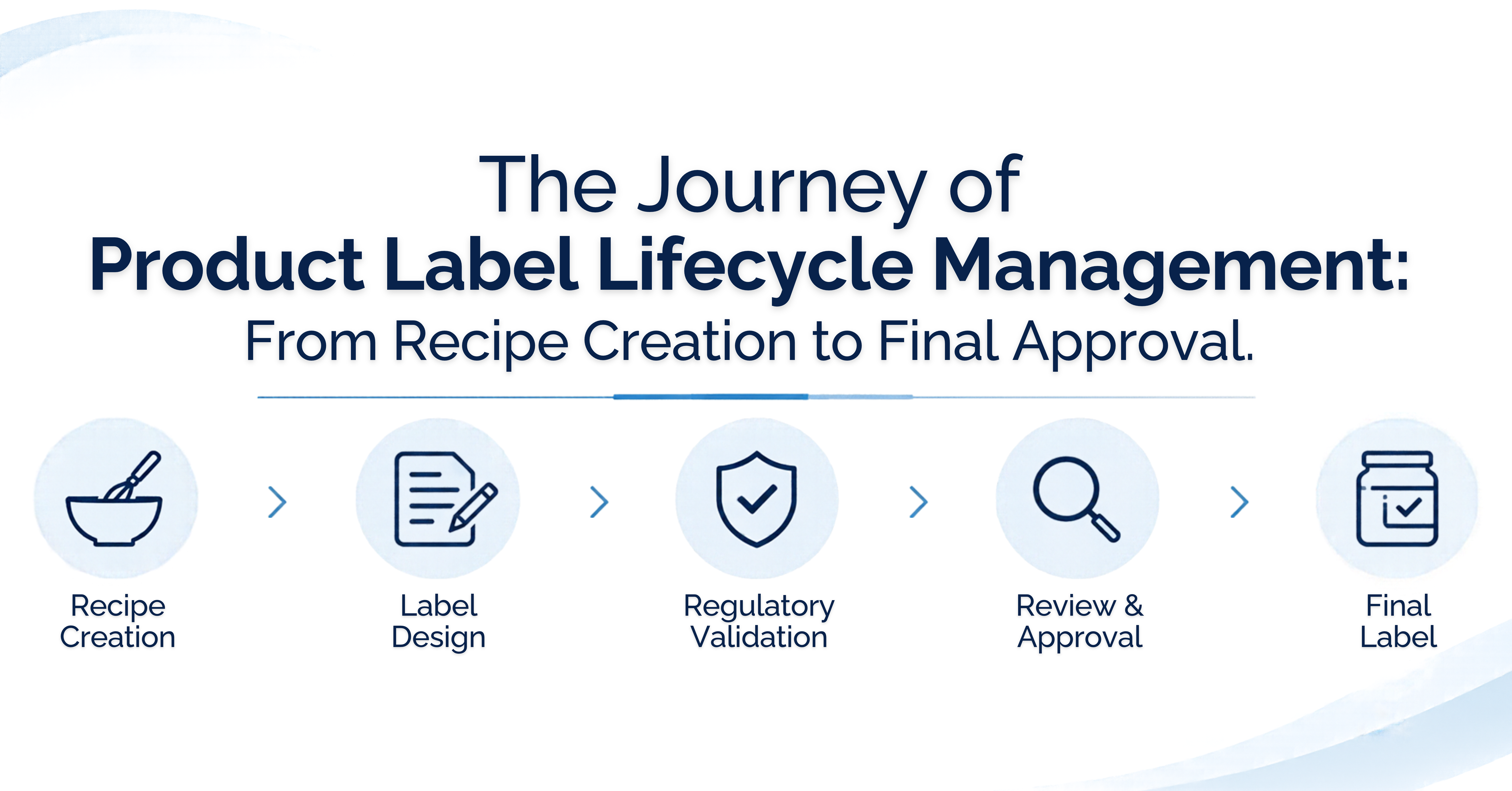
Every food product has a journey before it reaches the shelf, and its label is an important part of that journey.
From the first recipe and ingredient selection to quality testing, regulatory review, packaging artwork and final approval, multiple teams work together to bring a food product to market. Each stage builds on the information and decisions made in the previous one, making Product Label Lifecycle Management a cross-functional process involving Product Development, Quality, Regulatory, Marketing and Packaging teams.
Each stage involves different teams, each contributing specific information and expertise to the product.
In many food companies, this journey is often managed through a combination of people, established workflows and Product Lifecycle Management (PLM) systems that help organise product information and coordinate activities. However, product development and regulatory compliance do not always begin together. While product decisions start at the formulation stage, regulatory review may enter the workflow later, as the product moves towards labelling and packaging.
The complexity increases when food products are intended for multiple international markets. A product developed in one country may need to meet different regulatory frameworks across its export destinations. Requirements for ingredient permissibility, product categorisation, nutritional declarations, allergens, mandatory statements and label presentation can vary from one market to another.
But where does regulatory compliance fit into this journey?
To understand this, let us look at the stages of Product Label Lifecycle Management and how each contributes to the final food label.
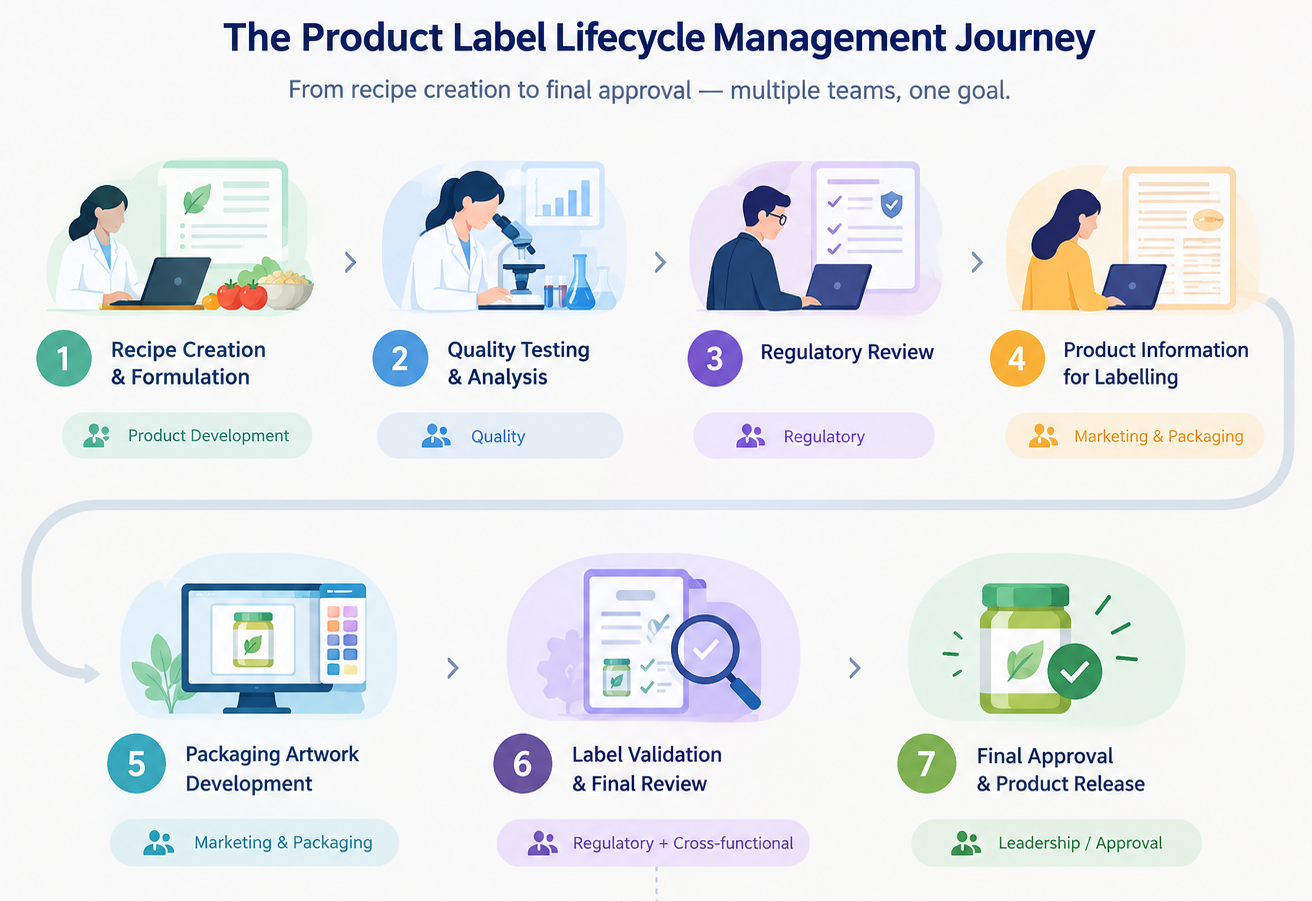
1. Recipe Creation and Product Formulation
The product lifecycle begins with the Product Development (PD) team creating the recipe.
At this stage, the Product Development team establishes the product formulation by:
Creating the recipe and defining ingredient quantities.
Identifying raw materials and their specifications.
Mapping raw materials to internal material codes.
Recording relevant physical and chemical characteristics.
Entering product information into the PLM system.
Submitting the recipe for review and approval.
The recipe establishes the foundation for the product's identity and composition. The information recorded at this stage becomes an important reference for subsequent testing, regulatory assessment and label preparation.
Regulatory considerations are also relevant here because the ingredients, additives and product category may determine which regulatory and permissibility requirements apply to the finished product.
This makes recipe creation an important starting point in the product label lifecycle.
2. Quality Testing and Product Analysis
Once the recipe has been created and submitted, the process moves to Quality Assurance (QA) or Quality Control (QC), depending on the company's workflow.
The team evaluates the product against the parameters required for its development and approval.
This stage may include:
Testing relevant physical and chemical parameters.
Conducting nutritional analysis.
Reviewing product specifications.
Recording laboratory test results.
Uploading test reports against the relevant product or recipe in the PLM system.
Reviewing and approving the results.
The test reports provide documented information about the product and its characteristics.
These details are relevant to the subsequent stages of the lifecycle, particularly when nutritional information and other product-specific declarations need to be established for food labelling.
Once the required testing and internal approvals are completed, the product progresses to the next stage.
3. Regulatory Review of the Product
The Regulatory team reviews the product against the applicable food regulations and requirements for its intended market. This review may cover product categorisation, ingredient and additive permissibility, formulation requirements and other conditions relevant to the product.
The team considers the product information and supporting documentation available at this stage to determine the applicable regulatory requirements.
This review establishes an important connection between what the company intends to manufacture and what it is permitted or required to declare under the relevant regulations.
In a typical cross-functional workflow, the Regulatory team may become involved after the recipe has been developed and the required testing has progressed.
However, regulatory requirements are relevant from the point at which the formulation is being defined. The product's composition and category can influence the regulatory considerations that apply throughout its lifecycle.
The journey of product lifecycle management and the journey of regulatory compliance are closely connected, beginning with the product itself.
4. Preparation of Product Information for Labelling
Once the product information and relevant regulatory requirements have been reviewed, the process should move towards preparing the information required for the product label.
The relevant teams compile and review the details that need to be communicated to consumers and included on the packaging.
Depending on the product and applicable regulations, this information may include:
The name of the food
Ingredient declarations
Allergen information
Nutritional information
Net quantity and other mandatory declarations
Claims, disclaimers and other applicable statements
The information is drawn from the product formulation, approved specifications, test reports and relevant regulatory assessments.
At this stage, the product moves from being a formulation managed internally to a product with defined information intended for its packaging.
The information prepared here becomes the basis for the subsequent artwork and label review stages.
5. Marketing and Packaging Artwork Development
With the product information prepared, the Marketing and Packaging teams work on the packaging artwork.
This stage brings together the product's brand identity, presentation and required label information.
The team works on the layout, typography, imagery, product descriptions and placement of declarations within the packaging design.
The artwork is then reviewed by the relevant stakeholders to ensure that it reflects the approved product information and meets the applicable requirements.
Regulatory review remains an important part of this stage as well because compliance depends not only on the information included but also, on how that information is presented on the final packaging.
Once the artwork is prepared, it moves through the designated review and approval process.
6. Regulatory Validation and Cross-Functional Review
The prepared label and packaging artwork undergo review by the relevant teams before final release.
The Regulatory team assesses the applicable declarations and requirements against the product information and the intended market.
Depending on the company's workflow, this stage may include:
Reviewing ingredient and allergen declarations
Verifying nutritional information
Checking mandatory statements and applicable claims
Reviewing relevant text and presentation requirements
Confirming that the artwork reflects the approved product information
Other stakeholders may review the artwork for product accuracy, brand requirements, quality considerations and packaging specifications.
The review process may involve multiple rounds of comments, revisions and approvals, with the relevant teams contributing according to their responsibilities.
This stage brings together the information and decisions made throughout the preceding stages of the product lifecycle.
7. Final Approval and Product Release
The final stage is the approval and release of the product label.
Once the required reviews have been completed and the necessary approvals have been obtained, the artwork is signed off for release according to the company's established process.
The final approved version serves as the reference for the packaging intended for production.
The company may retain the approved artwork, supporting product information, review comments and approval records within its PLM system or other designated records.
This completes the journey from recipe creation to final label approval, bringing together the work of Product Development, Quality, Regulatory, Marketing, Packaging and other relevant stakeholders.
Where Does Regulatory Compliance Fit in the Product Label Lifecycle?
Looking at the journey as a whole, each stage contributes to the final food label.
The recipe defines the product's composition.
Quality testing establishes product-specific information.
Regulatory review assesses the applicable requirements.
Product information is prepared for labelling, packaging artwork is developed, and
The relevant teams review and approve the final label.
People, established procedures and PLM systems play an important role in coordinating these activities and managing product information.
At the same time, regulatory compliance is not limited to the point at which the label is ready for review. It is connected to decisions made throughout the lifecycle, beginning with product formulation and continuing through testing, declarations, artwork and final approval.
This highlights an important consideration for the food industry: product lifecycle management and regulatory compliance are interconnected, and compliance needs to be recognised as part of the journey from the earliest stages of product development.
Consequently, the journey of a product label does not necessarily end with its domestic approval. It extends across international markets, with each market bringing its own applicable compliance requirements.
Understanding this relationship is an important step towards a more integrated view of product label lifecycle management.
Frequently Asked Questions
What Is Product Label Lifecycle Management?
Product label lifecycle management is the process of managing the information, reviews, artwork and approvals associated with a food label, from product development through to final release.
What Are the Main Stages of Food Product Lifecycle Management?
The process typically includes recipe creation, product formulation, quality testing, regulatory review, preparation of label information, packaging artwork development, final label validation and approval.
What Is the Role of PLM in Food Product Development?
Product Lifecycle Management (PLM) systems help food companies manage product data, formulations, specifications, documents, versions and workflows across different stages of product development.
When Does Regulatory Compliance Become Relevant in Food Labelling?
Regulatory compliance is relevant from the product formulation stage because ingredients, additives and product categorisation influence the requirements applicable to the finished product. It remains relevant through testing, label preparation, artwork review and final approval.
How Does International Regulatory Compliance Affect Product Label Lifecycle Management?
When food products are intended for multiple international markets, companies must account for the different food regulations applicable in each destination. Requirements for ingredient permissibility, product categorisation, nutritional declarations, allergens, mandatory statements, language and label presentation may vary across countries. Consequently, the same product may require multiple market-specific label versions, each undergoing regulatory validation before approval and release.

Michelle Britto
M.Sc. Foods, Nutrition and Dietetics, Registered Dietitian, Content Writer, Brand and Marketing Manager at LabelBlind® with over 7 years of experience
Recent Articles