Digital Transformation in Food Safety: Are Indian Manufacturers Ready for Global Compliance?
May 15, 2026
A food manufacturer once shared how a shipment to Australia was held back, not because of the product itself, but because the allergen information on the label was not marked in BOLD as required by local regulations. Neither the manufacturer nor the distributor had noticed the oversight. What appeared to be a small formatting error led to delays, relabelling costs, and disrupted deliveries, highlighting how even minor compliance gaps can impact global trade.
India’s ambition to go global is undeniable. But the reality is this, our compliance systems are still largely reactive, and that is a critical gap in a world where food regulations are becoming more complex, dynamic, and.
As regulations become dynamic and market-specific, Indian manufacturers can’t afford reactive systems. AI is shifting compliance from a post-production check to a real-time, embedded layer, enabling faster exports, fewer reworks, and truly scalable global growth.
How do food regulations differ across Global Markets?
Today, when an Indian manufacturer exports to markets like the European Union, New Zealand, Canada, Singapore, or the United Kingdom, they are not entering one unified regulatory system.
They are entering multiple, highly complex regulatory ecosystems.
Each market comes with:
Different labelling formats
Unique additive permissions
Country-specific allergen declarations
Distinct interpretations of safety and acceptability
And most importantly, these regulations are constantly evolving.
An additive permitted today may be restricted tomorrow. A color allowed in one country may require a warning label in another. A label compliant in India may be rejected in Canada due to missing bilingual requirements.
The risk doesn’t just increase, it multiplies.
Take the example of Titanium Dioxide, once widely used in food products.
In the European Union, it is now considered unsafe due to genotoxicity concerns
In other markets, it may still be permitted
This creates a major challenge:
The same formulation can be compliant in one country and completely non-compliant in another.
Similarly, Canada highlights how deep compliance requirements can go.
To sell a packaged product in Canada, manufacturers must ensure:
Mandatory bilingual labelling (English and French)
Strict nutrition table formats
Front-of-pack labelling requirements
Detailed allergen declarations
And to make matters more complex, regulations can change in cycles as short as two years, creating continuous compliance pressure.
What is the hidden problem of food compliance?
A single product exported globally may require:
Multiple ingredient validations
Different additive approvals
Separate label formats
Continuous updates with regulatory changes
Yet, most companies are still managing this manually. Which means, compliance happens at the end of the process, after formulation, after development, sometimes even after packaging.
Teams build products first and then ask: “Is this compliant?”
That approach is fundamentally broken in today’s global landscape.
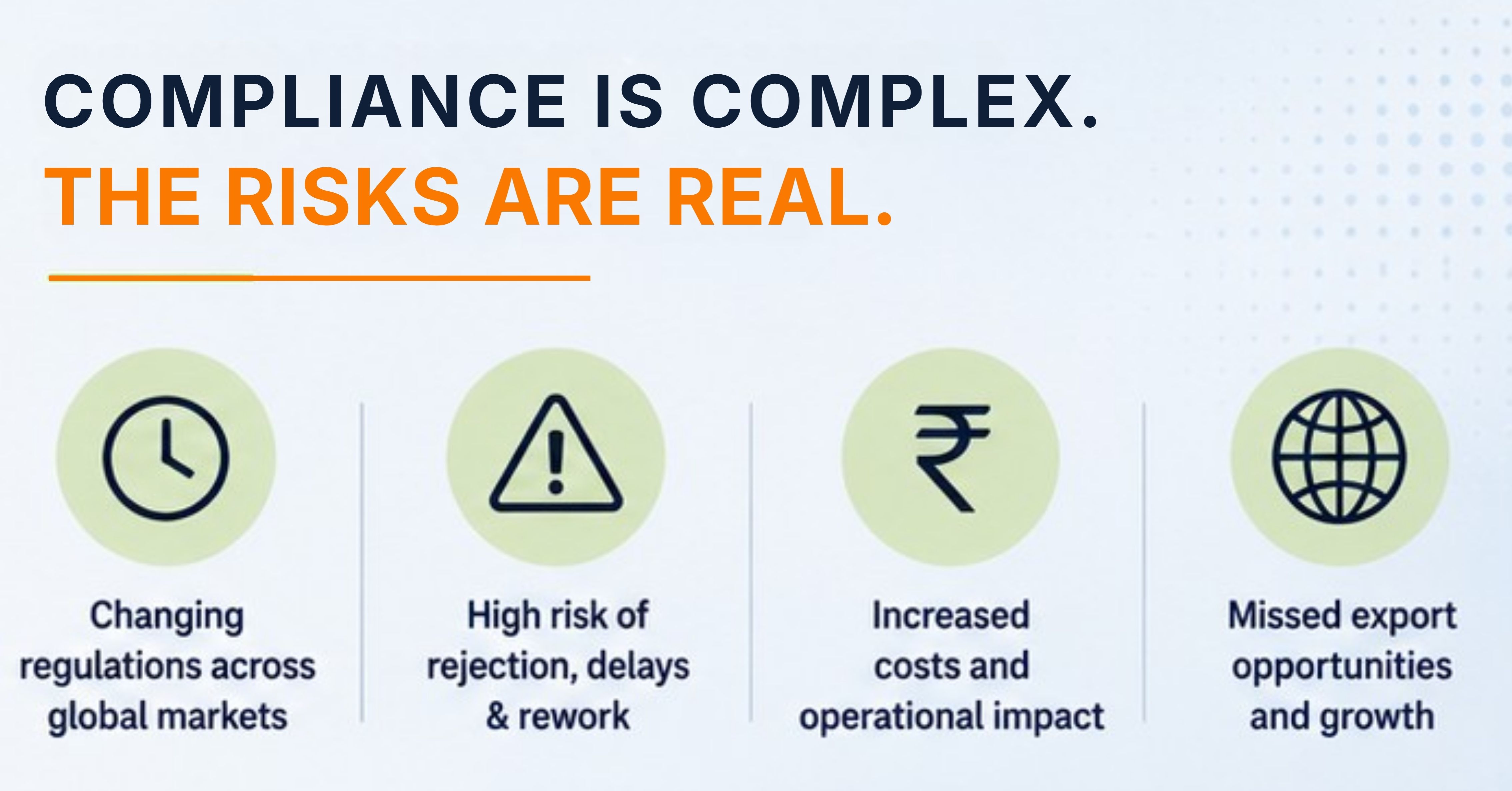
What are the costs of reactive compliance in food exports?
This reactive model leads to:
Delays in product launches
Rework and reformulation
Increased operational costs
Missed export opportunities
In a global market, speed and accuracy are everything. And reactive compliance delivers neither.
What is the shift we need in regulatory compliance systems?
The real problem is the lack of real-time, scalable systems to manage that complexity. What the industry needs is a shift:
From manual → automated
From reactive → proactive
From fragmented → integrated
Compliance must become: Embedded, continuous, and intelligent
Why is Artificial Intelligence now foundational?
This is where Artificial Intelligence (AI) becomes critical, but as foundational infrastructure.
AI can:
Process regulatory changes across countries in real time
Map ingredient-level compliance instantly
Validate products across multiple markets simultaneously
What manual systems cannot deliver, speed, consistency, and scalability, AI does effortlessly. And this transformation is already underway.
What does AI-driven compliance look like in practice?
AI is transforming compliance from a time-intensive process into a real-time, transparent system, reducing turnaround from hours to minutes and enabling validation at every stage, from formulation to final label.
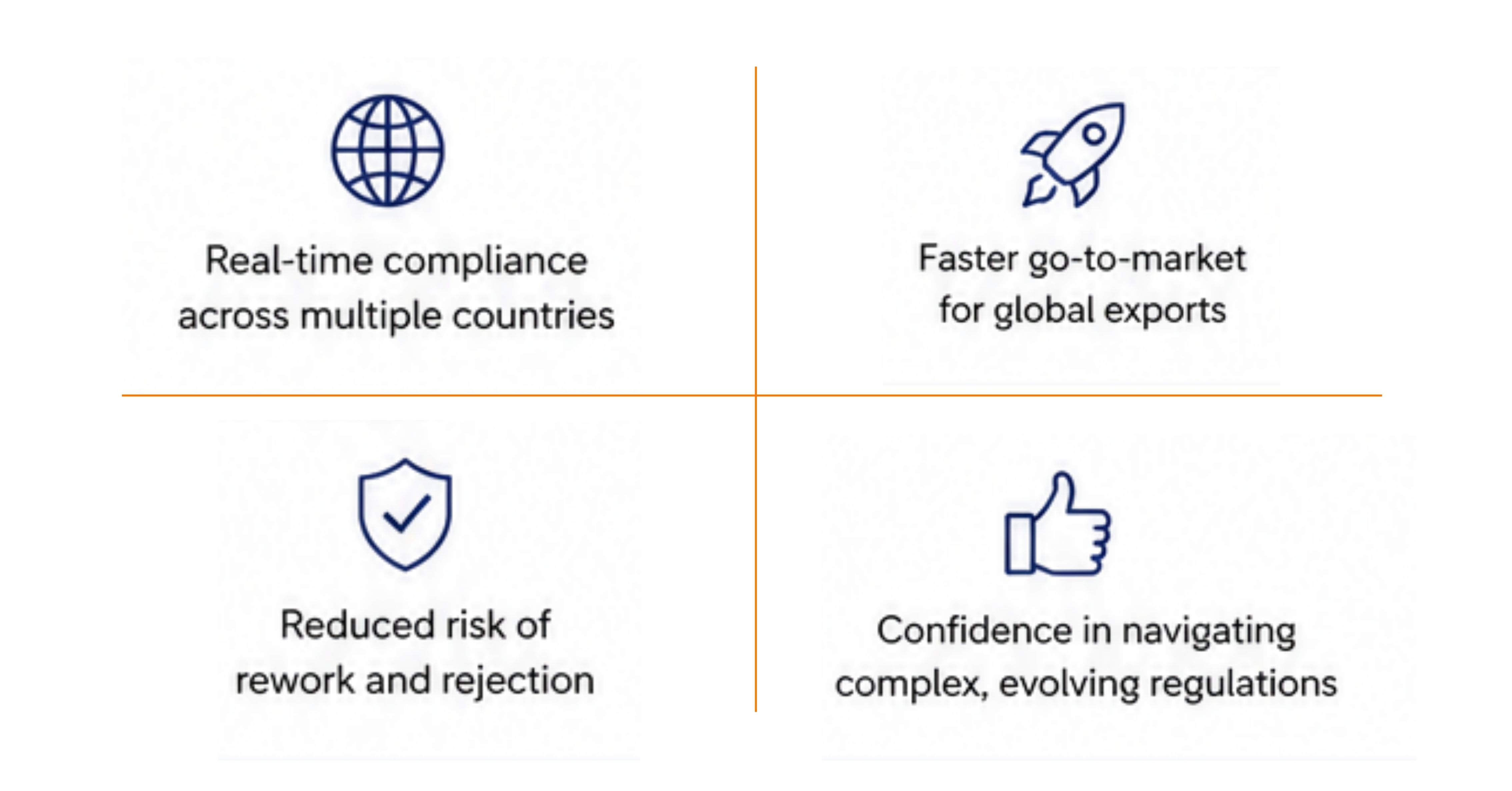
Here’s what that means in practice:
1. At the Formulation Stage
Instantly identify non-compliant ingredients for target markets
Avoid costly reformulations later
2. During Product Development
Test if one formulation works across multiple geographies
Make informed decisions early
3. At the Labelling Stage
Automatically generate country-specific labels
Ensure compliance with format, language, and structure
4. Before Market Entry
Validate compliance with high accuracy
Reduce rejection risks
How does compliance become a growth enabler instead of a bottleneck?
With AI, compliance is no longer a barrier.
It becomes an enabler of speed, scale, and confidence.
And this shift is crucial as India’s global food footprint expands.
Because here’s the truth:
More markets = More regulations
More regulations = More risk
More risk = Need for stronger systems
And this growth is exponential
Is AI the future of digital food safety and compliance?
Global success in the food industry will not be driven by product alone. It will be driven by compliance readiness. The companies that will lead are not the ones fixing compliance at the end. They are the ones who are designed to be compliant from the start
How can India become a global leader in food exports through compliance?
Build compliance into the product development process.
Invest in digital and AI-led compliance systems.
Treat compliance as a growth strategy.
ABOUT LABELBLIND
LabelBlind® Solutions Pvt Ltd. (incorporated in 2023) is India’s 1st AI-led Digital Food Labelling SAAS Solution. We work in the space of digitizing food labelling solutions for domestic and global markets to strengthen food labelling compliances for companies. Our flagship product, FoLSol® digitises labelling requirements for Packed Food, Fresh Food, Food Ecommerce and Food Export Companies. FoLSol® makes food labelling compliance efficient for regulatory teams by reducing dependency on manual processes and streamlines workflows end to end, from label creation to label validation.LabelBlind® is an ISO 9001:2015 certified company

Michelle Britto
M.Sc. Foods, Nutrition and Dietetics, Registered Dietitian, Content Writer, Brand and Marketing Manager at LabelBlind® with over 7 years of experience
Recent Articles