Could a Small Food Regulatory Compliance Mistake Be Putting your GCC, US, or EU Consignment at Risk?
July 11, 2026
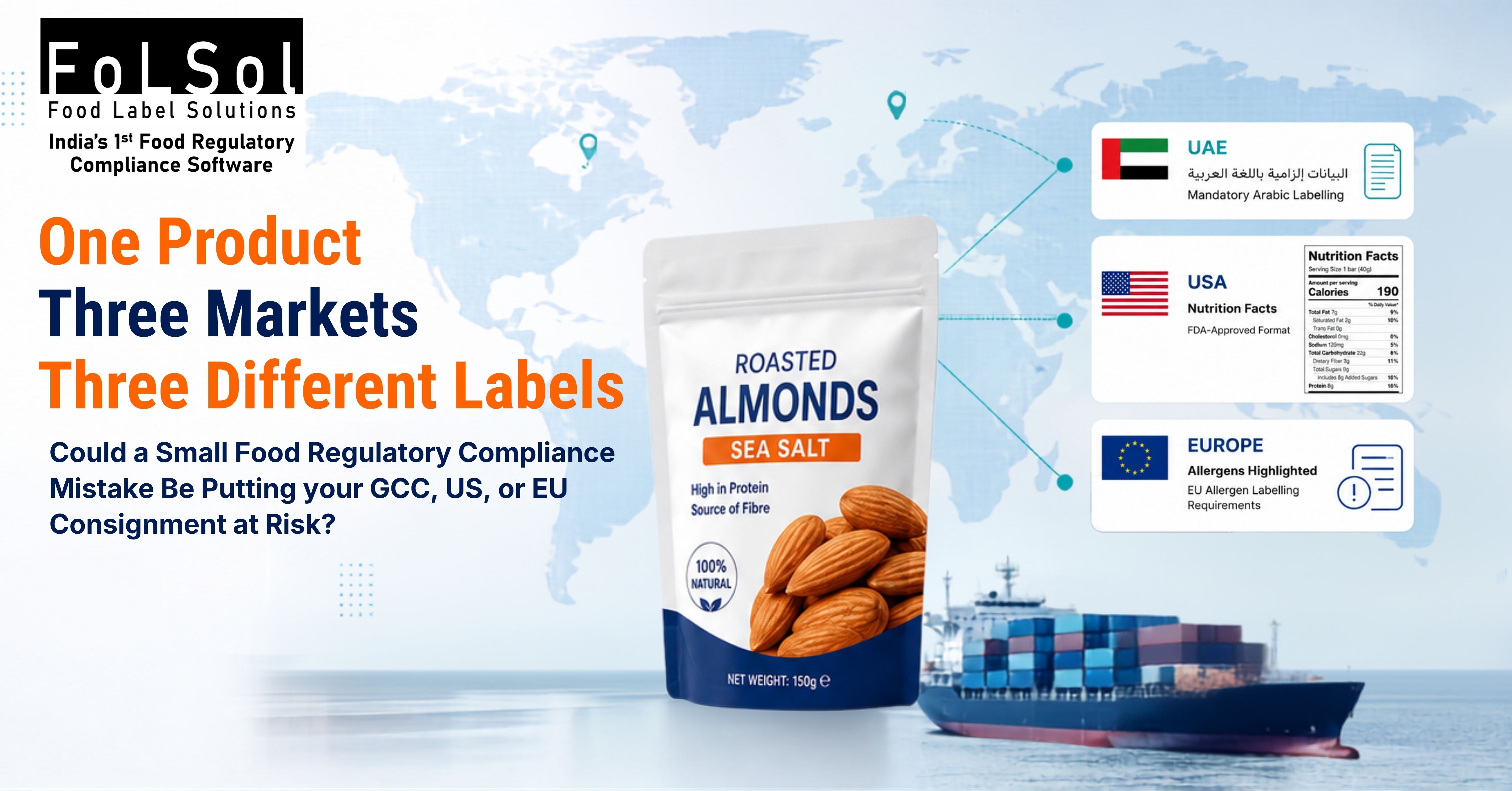
A food manufacturer has spent months preparing an export order. The consignment is shipped to international destinations in the UAE, the United States, and Europe.
During the final review, the regulatory team at the port spots a few issues. The UAE label is missing mandatory Arabic text. The US pack uses the wrong Nutrition Facts format. One European label lists allergens but does not highlight them as required.
The product inside every pack is exactly the same. The labels are however not meeting the compliance standards and the consignment is held up.
As Indian food businesses expand into global markets, food labelling has become much more than a packaging requirement. It is a key part of regulatory compliance, customer confidence, and successful exports.
Why Are Export Labels Different for Every Market?
Every country has its own labeling requirements covering nutrition information, ingredients, allergens, claims, languages, and formatting.
For example:
A snack exported to the UAE may require mandatory Arabic labeling to meet GCC regulatory compliance requirements.
A breakfast cereal entering the United States must display nutrition information using the FDA-approved Nutrition Facts format to support US regulatory compliance.
A chocolate spread sold in Germany must clearly emphasize allergens within the ingredient list to comply with UK and EU regulatory compliance requirements.
Managing these differences manually becomes increasingly difficult as product portfolios and export markets grow.
Where Do Labelling Challenges Begin?
Labelling comes as the last point of process compliance for food companies. The product is ready, the packaging design is finalised, the labelling standards now need to meet the standards of multiple countries.
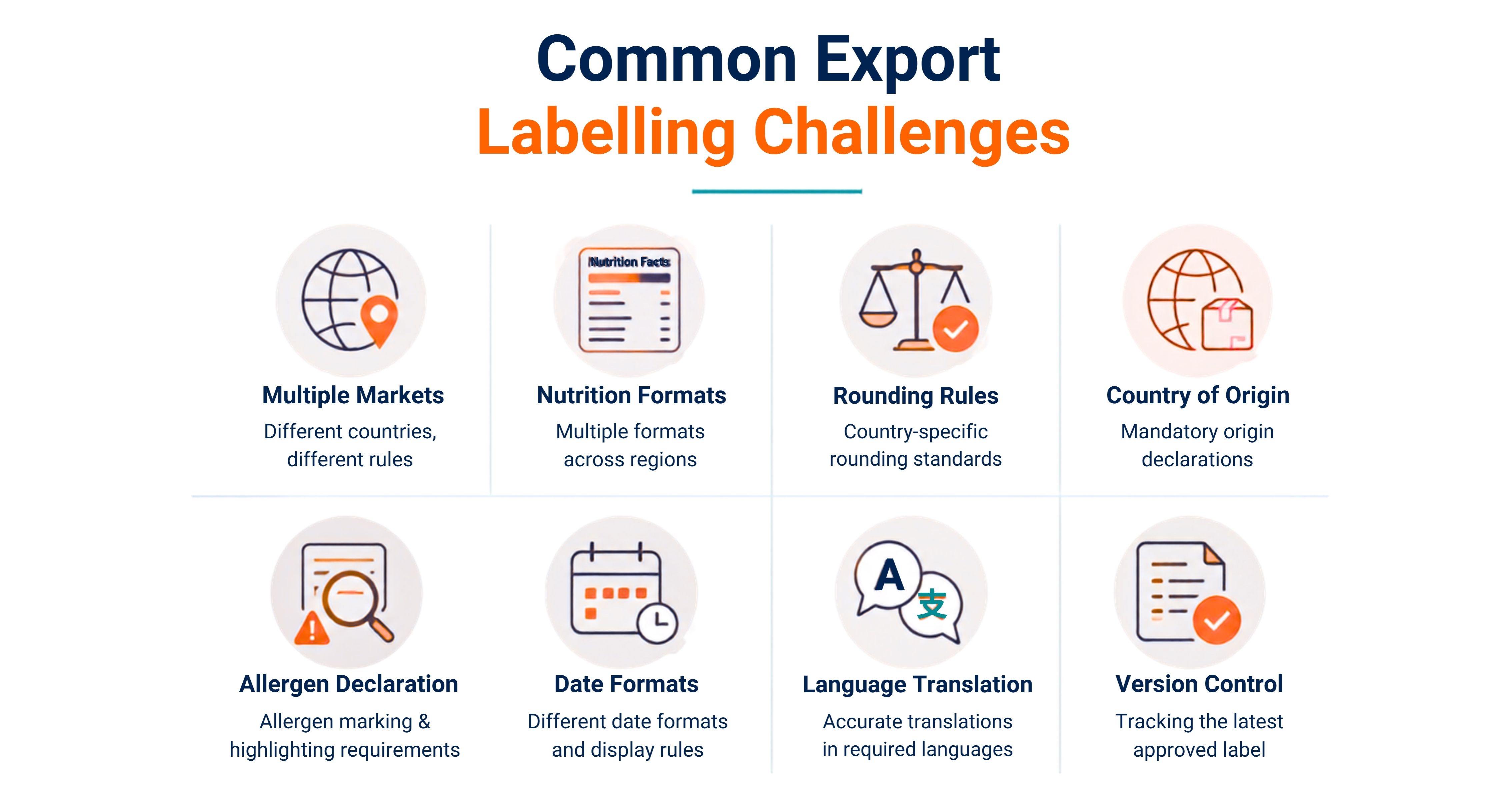
Common challenges include:
Multiple labels for different export markets
Multiple nutrition formats
Rounding off rule
Mention of Country of Origin
Mandatory declarations
Allergen marking
Date formats
Manual updates across spreadsheets and artwork files
Ingredient changes not reflected on packaging
Language translations
Difficulty tracking the latest approved label
As businesses expand internationally, these manual processes become harder to manage.
What Is The Business Impact?
A labelling issue affects more than just packaging.
Consider a company exporting the same protein bar to Saudi Arabia, the United States, and France. Each market requires a different label version. If one shipment leaves with an incorrect label, the business may need additional reviews, packaging corrections, or revised documentation before the product reaches customers.
This is why food export labelling has become an essential part of exports regulatory compliance.
Why Does Digital Label Compliance Management Matter?
As businesses grow, managing labels through emails and spreadsheets becomes increasingly complex.
A company selling 50 products across five countries could be managing hundreds of label variations based on language, nutrition formats, ingredients, and regulatory updates.
Using label compliance management software or modern regulatory compliance software, allows businesses to centralize label information, maintain version control, and standardize approvals across teams. Businesses can also reduce manual effort while improving consistency across export markets.
How does FoLSol® Support Global Food Exports for Indian Companies?
FoLSol® brings labelling compliance, and regulatory management onto one platform, helping food businesses manage labels across multiple countries from a single source of truth.
Instead of maintaining email communications for managing labels for UAE, the US, and European markets, teams can generate market-specific labels, manage approvals, and maintain complete version control within one system.
By combining regulatory intelligence with digital workflows, FoLSol® helps food businesses:
Create 100% compliant labels <15 minutes
Generate accurate multi-country labels meeting country-specific regulations like nutrition information, allergens and language translation.
Improve food export labelling workflows
Support GCC regulatory compliance, US regulatory compliance, and UK and EU regulatory compliance within minutes.
Final Thoughts
Global food exports require labels that meet the regulatory expectations of every destination market.
Whether it is Arabic labeling for the GCC, an FDA-compliant Nutrition Facts panel for the US, or allergen declarations for the EU, every detail contributes to successful market access.
With the right food regulatory compliance software, food businesses can simplify compliance, improve productivity, and confidently prepare every shipment for global markets.

Michelle Britto
M.Sc. Foods, Nutrition and Dietetics, Registered Dietitian, Content Writer, Brand and Marketing Manager at LabelBlind® with over 7 years of experience
Recent Articles